
ADHD, OCD and Soulmates Part 3
Part 3 of a 5-part series
My Journey with ADHD, OCD and Soulmates
The Cynical Romantic
A Quick Note Before We Dive In
These posts are memoir, not medical records. I’m a late‑diagnosed, Cynical (Yet Still Hopeful) Romantic writing about ADHD, OCD‑flavored thinking, and the questionable relationship choices that followed—not a therapist handing out diagnoses or advice. If you recognize pieces of yourself in my stories, take them as a nudge to get curious about your own patterns, not a verdict about your brain or your love life. Your history is yours, and if anything here stirs things up, a qualified mental health professional who knows you will always be a better guide than a stranger on the internet with a complicated soulmate résumé and a keyboard.
When Romance Turns Into a Full-Time Role

If my ADHD diagnosis gave me a new dictionary, Post 3 is where I finally looked up the word “performance.” Somewhere along the way, love stopped being something I experienced and became something I performed. I wasn’t just in relationships; I was starring in them.
On the outside, it looked noble: I showed up, provided, fixed things, held it together. On the inside, it felt like I was playing a character called “Her Perfect Match,” terrified the costume would slip and she’d see the understudy underneath.
The Big Gesture I Still Cringe About
There’s one scene that still makes me wince. Money was tight, tension was high, and I had this brilliant idea that if I just did something huge, it would reset everything. So, I took on extra hours, shuffled bills, and pulled off a grand gesture—a trip, a purchase, a “see how much I love you?” kind of move I absolutely could not afford.
She was thrilled. For about a week, the air softened. We laughed more. The petty jabs quieted down. I felt like I’d finally cracked the code: big sacrifice equals big love.
Then real life came back. The credit card bill arrived. The old patterns resurfaced. The gesture faded into the background, and I was left with more debt and the creeping sense that I’d just paid a premium price for a temporary high.
In my head, I framed it as “romantic.” In hindsight, it was my hero complex and my ADHD teaming up: impulsive decision, driven by the need to fix an unbearable feeling right now, without much thought for next month.
Limerence: The Lightning-Bolt Version of Love
Back then, I didn’t have a word for the way I fell in love. I just knew it felt like a lightning strike: obsessive thinking, intense longing, a sense that this person was suddenly the main plot of my life.
Later, I learned people call that limerence—a state of extreme infatuation where your brain loops on someone, you idealize them, and your mood swings with every perceived sign of closeness or distance. For an ADHD brain that already leans toward hyperfixation and chasing dopamine, limerence isn’t just love; it’s a full‑body hobby.

I can see it now in my own pattern:
I’d meet someone.
Something would click—maybe a look, a joke, a conversation at 1 a.m.
Within days, my thoughts were orbiting them.
Within weeks, I was imagining shared futures.
Within months, I was making decisions that made sense only inside that bubble.
To me, it felt like destiny. To a more neutral observer, it probably looked like I’d strapped myself to a rocket without checking the fuel.
Falling For the Story, Not the Person
Here’s the part I didn’t want to admit: often, I was more in love with the story than with the human being sitting across from me.
The story went like this: I’m a good man who just needs one woman to see it, fully and finally. When she does, we’ll build a life that proves everyone else wrong. Cue the montage.
Once someone slotted into that narrative—especially if she used soulmate language—everything else became supporting evidence. Her good traits were proof she was The One. Her bad traits were obstacles we’d heroically overcome. My job was to hold the plot together, no matter how many edits reality demanded.
Under that pressure, I didn’t see her clearly. I saw her as a co‑star in a movie I desperately needed to have a happy ending. Limerence gave me the high. The soulmate script gave it a title. My hero complex provided the stunts.
The actual woman? She was there, of course. But I often met her through the filter of who I needed her to be.
How ADHD Powered the Hero Complex
ADHD didn’t create my hero tendencies, but it did throw gasoline on them. That mix of impulsivity, emotional intensity, and rejection sensitivity made the hero role feel almost inevitable.
Impulsivity meant I said yes before I thought things through.
Emotional intensity meant her pain hit me like an emergency.
Rejection sensitivity meant any disappointment from her felt catastrophic.
Put those together and you get a man who’s constantly volunteering for rescue missions. Need money? I’ll figure it out. Need a ride, a favor, a last‑minute bailout? Done. Need me to change my plans, my habits, my boundaries? Give me five minutes and a mild guilt trip.
To the outside world, I looked like “such a caring partner.” Inside, I was running disaster response for feelings I didn’t know how to tolerate. Saying no felt like inviting abandonment. Saying yes felt like buying insurance.
When Being the Hero Becomes the Problem
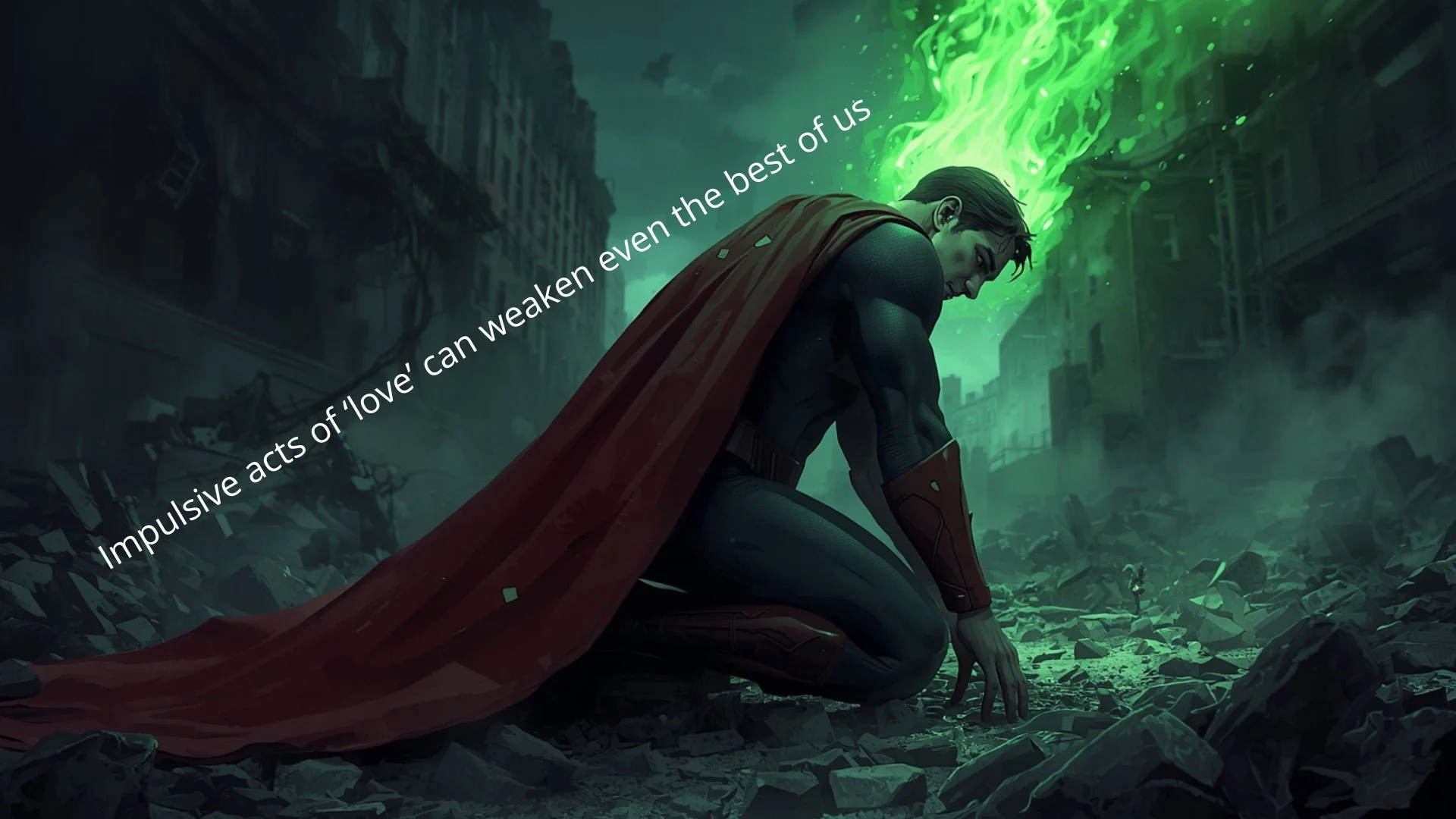
The trouble with being the hero is that you usually end up fighting the wrong dragon. I was busy slaying external problems—bills, conflicts, bad days—while ignoring the internal ones: my fear of being left, my lack of boundaries, my unwillingness to see my partners as full, flawed humans instead of damsels, villains, or prize givers.
Heroics also conveniently kept me from looking at whether I actually liked the relationship I was in. If I was busy saving it, I didn’t have to ask if I wanted it. If I was busy proving I was a good man, I didn’t have to ask why I only felt valuable when someone was in crisis.
At some point, the hero complex stops being romantic and starts being a liability. It makes it harder for your partner to be honest, because they know any vulnerability will trigger a full‑scale rescue. It makes it harder for you to be honest, because you’ve built an identity on being the one who can handle it all.
The Soulmate Costume I Forgot to Take Off
In my soulmate series, I joked about the “soulmate costume”—the way we try on this idea of being someone’s perfect fit and then trip over the hem. Writing that, I pictured other people. Rereading it, I realized I was describing my own reflection.
With my first wife and later relationships, the costume looked like this:
Saying “we’re soulmates” out loud even when my inner voice stayed quiet.
Ignoring the parts of me that felt unseen, unheard, or just uneasy.
Doubling down on the performance whenever cracks appeared—more romance, more sacrifice, more fixing.
I thought if I played the part well enough, the feeling would catch up. That’s not how it works. Costumes can only carry you so far. At some point, the seams give out, or you do.
Naming the Pattern (So I Can Stop Repeating It)
Blending what I’ve learned about ADHD, limerence, and attachment with these memories hasn’t been comfortable, but it has been clarifying. It let me name the pattern:
Feel unseen or “not enough.”
Meet someone who makes me feel chosen.
Go all‑in fast—emotionally, logistically, financially.
Ignore discomfort and red flags because the story is too good to lose.
Over‑function as the hero when things wobble.
Burn out, implode, or both.
Seeing it written out like that doesn’t magically fix anything. But it does something almost as important: it breaks the spell. Once you can recognize the script, it’s harder to pretend you’re just improvising.
Where We’re Heading Next

In the next post, I’m going to shift from the lightning‑bolt side of my brain to the spreadsheet side: the part that wants certainty, rules, guarantees. We’ll talk about OCD‑flavored thinking, relationship doubt, and how my need for a perfectly ordered love story made the soulmate myth feel both safe and suffocating.
For now, I’ll leave you with this:
When you look at your own history, can you spot the places where you were playing a role in love—hero, savior, perfect partner—instead of showing up as an actual, messy human?
CTA:
If you’d like to share, I’d love to hear about a time when you realized you were in love with the idea of a relationship more than the reality. What gave it away?
