
ADHD, OCD and Soulmates Part 4
Part 4 of a 5-part series
My Journey with ADHD, OCD and Soulmates
The Cynical Romantic
A Quick Note Before We Dive In
These posts are memoir, not medical records. I’m a late‑diagnosed, Cynical (Yet Still Hopeful) Romantic writing about ADHD, OCD‑flavored thinking, and the questionable relationship choices that followed—not a therapist handing out diagnoses or advice. If you recognize pieces of yourself in my stories, take them as a nudge to get curious about your own patterns, not a verdict about your brain or your love life. Your history is yours, and if anything here stirs things up, a qualified mental health professional who knows you, will always be a better guide than a stranger on the internet with a complicated soulmate résumé and a keyboard.
.
When Love Becomes a Logic Puzzle
If you’ve ever tried to spreadsheet your way out of a feeling, welcome to my side of the table. By the time I started noticing my ADHD patterns in love, another part of my brain was already hard at work trying to fix everything with…logic. Not the useful kind, either. The obsessive, circular kind that feels productive right up until you realize you’ve been arguing with yourself in the shower for 40 minutes.
I like to think of it as my internal courtroom. On one side: “This is it, this is your person.” On the other: “Something’s off, and if you were smarter, calmer, or more honest, you’d know exactly what.” My job, apparently, was to be the overworked attorney trying to win both cases at the same time.
The “If I Really Loved Her…” Thought Loop
A lot of my overthinking boiled down to variations on one sentence:
“If I really loved her, I would/ wouldn’t/ shouldn’t…”

If I really loved her, I wouldn’t feel anxious.
If I really loved her, I wouldn’t notice other people.
If I really loved her, I’d never doubt this.
It sounds reasonable, right up until you realize you’ve built a whole belief system on an imaginary standard of “real love” that no actual human can live up to. Any stray feeling, any moment of boredom, irritation, or doubt became Exhibit A that something was fundamentally wrong—with her, with us, with me.
Instead of accepting that long‑term relationships come with mixed feelings, my brain treated every wobble like a crime scene. The question was never, “What’s happening between us?” It was, “What does this say about me as a person, and can I prove I’m not a monster before breakfast?”
Relationship Brain vs. Spreadsheet Brain
On good days, my relationship brain and my spreadsheet brain tried to work together. I’d feel something—affection, frustration, unease—and then start cataloging it.
Date: Tuesday.
Symptom: Mild dread before date night.
Hypothesis: I’m falling out of love. Or I ate bad leftovers. Hard to say.
I’d mentally log every interaction, every text response time, every shift in tone. Then I’d run it through a filter of “What would a normal person feel?” (As if I had any idea.)
My OCD‑ish side craved certainty. It wanted a clean formula: X feelings + Y behavior = True Soulmate or Fraud. My ADHD side, meanwhile, bounced between hyperfocus and distraction, making the data wildly inconsistent. Put them together and you get a man who desperately wants a verdict and keeps tampering with his own evidence.
The Reassurance Addiction
Because my internal monologue never shut up, I got very good at seeking reassurance without calling it that.
“Do you still love me?” (Asked jokingly, but not really.)
“You’re happy, right?”
“We’re okay, yeah?”
Sometimes I didn’t say it out loud. I just watched her reactions like a hawk. Did she text back as fast as yesterday? Did she reach for my hand first this time? Did she laugh at the joke she usually laughs at?

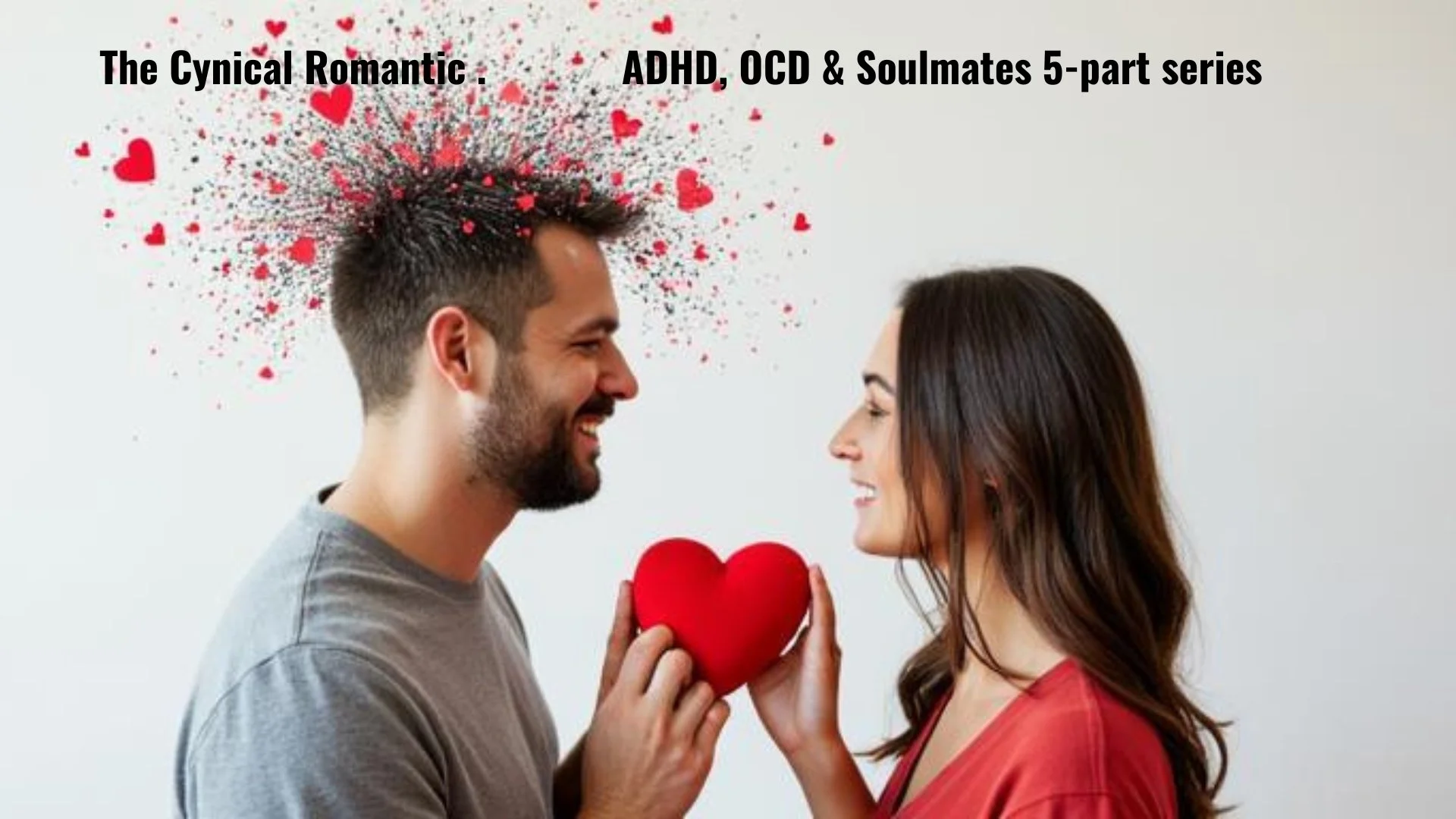
A heart in chao
Each tiny signal went into the mental courtroom as evidence. One smile could buy me a day of relief. One off comment could send me spiraling into “We’re doomed, aren’t we?” territory. It’s exhausting, building your sense of security on micro‑expressions and response times.
The punchline, of course, is that no amount of reassurance ever lasted. The doubt always respawned with a new disguise. You can’t out‑hug a thought loop.
Soulmates, But Make It Quality Control
This is where the soulmate idea got weaponized. Instead of a sweet, romantic notion, it became my quality‑control metric.
A real soulmate, in my head, came with guarantees:
No doubt.
No inconvenient attraction to anyone else.
No ambivalence, ever.
So when normal human feelings showed up—irritation, boredom, fleeting crushes, days where I wanted to be alone—I didn’t treat them as data. I treated them as red stamps: “Defective. Return to sender.”
I’d obsessively test the relationship: replay conversations, compare her to exes, compare myself to some idealized version of “the man who is sure.” I wasn’t asking, “Is this relationship healthy?” I was asking, “Can I find one piece of evidence that proves we’re not meant to be, so I can stop feeling this gnawing uncertainty?”
Spoiler: if you’re looking for evidence that something’s wrong, you’ll always find it.
The Illusion of the Perfect Feeling
One of the cruelest tricks my brain pulled was convincing me that somewhere out there was a relationship where I would feel calm, certain, and blissfully doubt‑free forever. If I didn’t feel that way, it meant I was settling, broken, or secretly unloving.
So when my chest tightened on the drive over to see her, my mind didn’t say, “You’re tired,” or “You had a long week,” or “You’re scared because this matters.” It said, “See? If she were really your soulmate, you’d be excited, not anxious.”
When I noticed someone else attractive, my brain didn’t shrug and move on. It whispered, “Gotcha. If you really loved her, you wouldn’t have eyes for anyone else. Clearly this is wrong.”
It’s an impossible standard. No one passes. Not her, not me, not any relationship on the planet. But I didn’t know that yet. I thought my discomfort meant I hadn’t tried hard enough, chosen well enough, or purified my feelings enough.
Overthinking as a Love Language

A world class over-thinker.
I used to joke that overthinking was my love language. (Still do, to be honest.) On some level, it was true: the more I cared, the more I analyzed. I took my anxiety as proof of depth, as if worrying myself sick somehow meant I was more invested, more serious, more mature.
In reality, all that mental noise kept me from doing the simple, vulnerable thing: saying, “Hey, I’m scared,” or “I’m unsure today,” or “Can we talk about what’s actually happening between us?” It was easier to debate with myself about abstract soulmate criteria than to have an honest, awkward conversation in the living room.
Overthinking gave me the illusion of control. If I could just think hard enough, compare thoroughly enough, future‑cast accurately enough, I could guarantee I wouldn’t make a mistake. Of course, that never worked. I still made mistakes—just more slowly, and with more spreadsheets.
What the Loops Were Really Protecting
It took me a long time to understand that all this mental checking and testing wasn’t really about her at all. It was about me trying to outrun two core fears:
“What if I stay and it’s wrong?”
“What if I leave and I’m the one who’s broken?”
The soulmate myth promised a loophole: if I found The One, both fears would vanish. I wouldn’t have to risk staying in the wrong thing or leaving the right one, because I’d just know.
My OCD‑ish brain loved that idea. Clean. Simple. Certain. It’s just that real life refused to cooperate. No matter how much I analyzed, I never reached the mythical state of 100% knowing. So, I kept looping, hoping the next thought, the next test, the next late‑night mental trial would finally deliver a verdict.
It never did. What it did do was keep me from being fully present in the relationship I was actually in. Hard to notice the person in front of you when you’re busy interrogating your own feelings in the back of your mind.
Where We’re Heading Next
In the final post of this series, I’m going to talk about what it looks like to live and love now, knowing my brain does all this—and choosing to show up anyway. Less about fixing myself into certainty and more about building something real with all my doubts, quirks, and tendencies on the table.
For now, I’ll leave you with a question I still ask myself:
When you start spiraling about whether a relationship is “right,” are you actually evaluating them—or are you trying to guarantee you’ll never feel fear, grief, or regret?
CTA:
If you feel safe sharing, I’d love to hear about a time your own thoughts dragged you into a loop about love. What did your brain tell you had to be “perfect” before you could relax?
