
ADHD, OCD and Soulmates Part 2
Part 2 of a 5-part series
My Journey with ADHD, OCD and Soulmates
A Quick Note Before We Dive In
These posts are memoir, not medical records. I’m a late-diagnosed, Cynical (Yet Still Hopeful) Romantic writing about ADHD, OCD-flavored thinking, and the questionable relationship choices that followed—not a therapist handing out diagnoses or advice. If you recognize pieces of yourself in my stories, take them as a nudge to get curious about your own patterns, not a verdict about your brain or your love life. Your history is yours, and if anything here stirs things up, a qualified mental health professional who knows you will always be a better guide than a stranger on the internet with a complicated soulmate résumé and a keyboard.
The Day Someone Said “ADHD” Out Loud
I wish I could tell you my ADHD diagnosis came in a dramatic, cinematic moment—sirens, breakthroughs, soft piano in the background. In reality, it was my doctor calmly asking a series of questions while I tried to be charming and not talk over her. (I did both, for the record.)
She asked about focus. I told her I could focus just fine—on the wrong things, for way too long, at very inconvenient times.
She asked about impulsivity. I thought about the relationships I’d jumped into like I was catching a flight that was already boarding.
She asked about emotional ups and downs. I laughed a little too loud.
By the time we were done, my life looked different without anything around me changing. The face in the mirror was the same. The history was the same. The only new thing was a word: ADHD.
And suddenly, a lot of my “romantic” behavior started to feel less like destiny and more like a pattern.
Reading My Marriage Like a Case File
Once the word was on the table, my brain did what it does best: hyperfocus.
I started reading about ADHD, especially in adults—especially in relationships. Words like “impulsivity,” “hyperfocus,” “rejection sensitivity,” and “emotional dysregulation” were everywhere, popping up like they’d been waiting for me.
So I did the thing I’d been avoiding. I mentally went back to my first marriage and began rewatching the highlights reel with this new script running underneath.
Suddenly, moments I’d filed under “true love” and “being a good man” started to look suspiciously like symptoms.
It felt a bit like opening an old case file and realizing you were the unreliable narrator the whole time.
Hyperfocus in a Suit and Tie
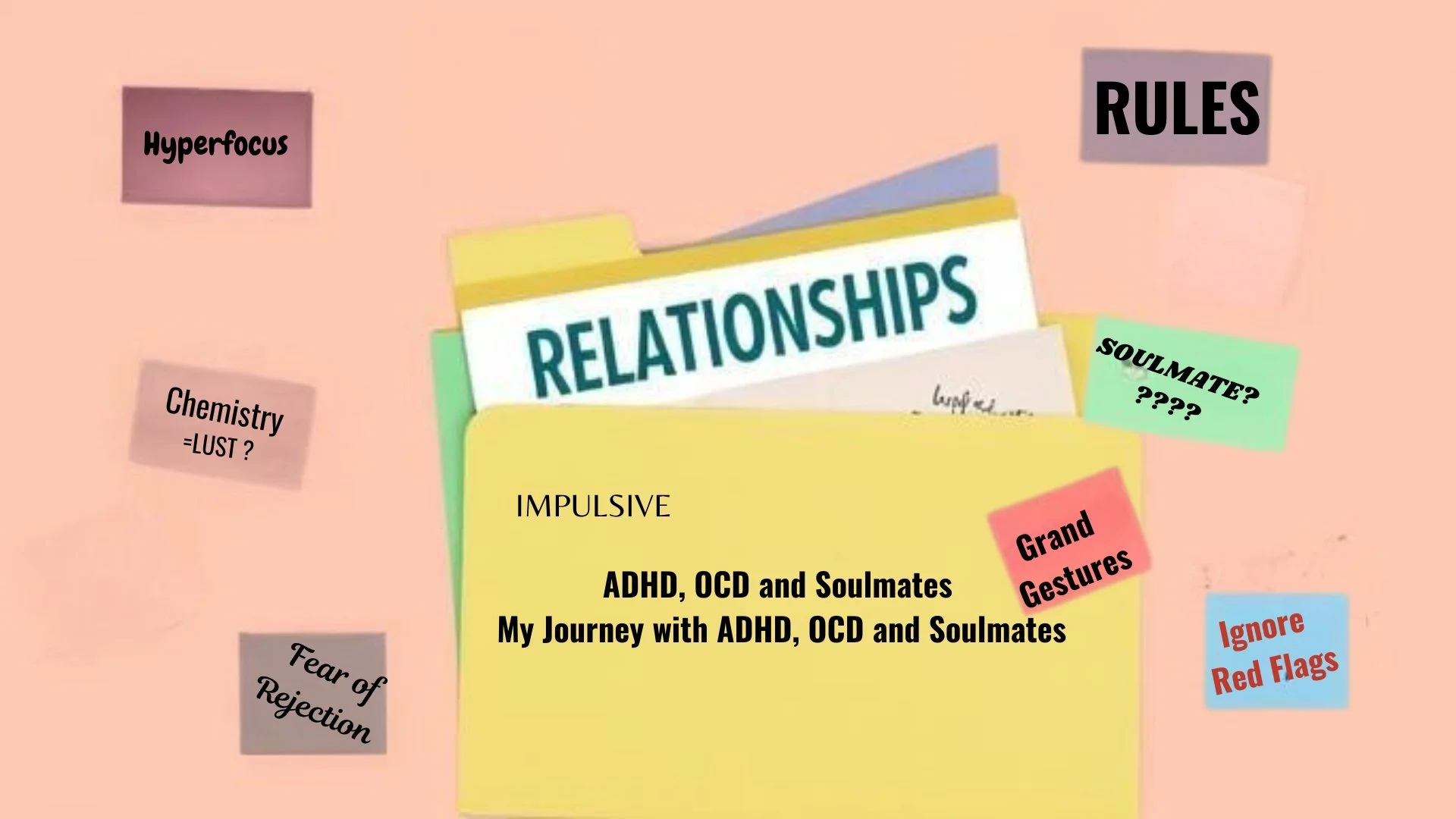
Take hyperfocus. Before I knew what it was, I called it commitment. Dedication. Old-fashioned loyalty.
When she called me her soulmate, I locked onto that relationship like a heat-seeking missile. I thought about her constantly. I prioritized her over almost everything else. I adapted my schedule, my finances, my friendships—my own needs—fast.
Hyperfocus, in plain English, is an ADHD brain’s tendency to lock onto something that feels interesting or emotionally important and pour all available attention into it, sometimes to the exclusion of basic self-care.
In a new relationship, that can look like movie-worthy devotion. It can also mean you don’t notice you’ve rearranged your entire life around someone you barely know.
In my case, it meant that once I was in, I was in. I didn’t take time to ask, “Do I actually like who I am with this person?”
I just worked harder to be who I thought she wanted.
Impulsivity Dressed Up as Romance
Then there’s impulsivity. For most people, that word conjures images of running red lights or buying a motorcycle at 2 a.m.
For me, it looked like fast-tracked intimacy and life decisions on a timeline that made perfect sense in the moment—and absolutely none a year later.
We went from “you’re my soulmate” to “we’re married” in about eighteen months. For some couples, that’s fine. For me, with the way my brain works, it meant I’d committed to a life before I’d really observed a relationship.
I wasn’t collecting data. I was writing a script and shoving reality into the costumes.
Impulsivity in relationships doesn’t always mean sleeping with someone too fast or moving in after three dates. Sometimes it’s subtler: agreeing to financial entanglements, changing jobs, distancing from friends, or reshaping your daily life around a person because “it just feels right.”
It felt right—until it didn’t. And by the time it didn’t, I was already heavily invested in being the hero.
The Hero Complex Meets Rejection Sensitivity
If hyperfocus and impulsivity put me in the relationship quickly, rejection sensitivity locked the door behind me.
I didn’t have that phrase back then. What I knew was that any sign of disapproval from her hit me like a punch. A sigh. A cold shoulder. A comment about what I “should have” done.
My brain didn’t read those as normal friction. It read them as imminent abandonment.
So I developed a hero complex. I over-functioned. I tried to anticipate needs before she voiced them. I took on more than my share around money, logistics, emotional labor.
If something went wrong, I blamed myself—and responded by doing more, giving more, proving harder.
On the outside, it probably looked like I was “such a good guy.” On the inside, it was a full-time panic management system.
If I could just be indispensable enough, she would never leave. If I could be the soulmate she said I was, I wouldn’t have to sit with the quiet fear that I wasn’t enough.
The Friends Who Saw It Before I Did
Here’s the part I don’t love admitting: other people noticed something was off long before I did.
A friend would say, “You seem…tired,” in that careful way that meant “tired and not yourself.”
A partner later down the road would comment that I was “always on,” always trying to solve, fix, rescue.
One woman—kinder and braver than I gave her credit for at the time—told me, “It feels like you’re performing ‘perfect boyfriend’ instead of just being here with me.”
I was offended. Of course I was here. Look at all the things I was doing. Look at how hard I was trying.
Looking back, she was right. I was there as a role, not as a person.
I didn’t know how to just be myself and trust that might be enough. I knew how to earn, how to prove, how to overcompensate. That’s great if you’re trying to keep a job. It’s less great if you’re trying to keep a heart.
“Great Guy” or Great Example?
For a long time, my favorite story about myself was that I was a great guy who just hadn’t met the right person.
It’s a comforting narrative. It makes you the protagonist and the victim at the same time. The world is unfair, people don’t recognize your value, and somewhere out there is the one person who will finally see you.
There was some truth in it. I am a decent human being in many ways.
But the ADHD lens forced me to admit that “great guy” wasn’t the whole picture. I was also a guy whose brain chemistry made him latch on too fast, ignore danger signs, and then throw himself into unhealthy dynamics because the alternative—facing rejection or being alone—felt unbearable.
Once I could see that, “great guy” stopped being a personality trait and started looking more like a coping strategy.
Being good, being generous, being the hero—those were the ways I tried to manage a brain that shouted, “You’re losing them!” every time someone needed space.
How ADHD Rewrote My Love Story
Here’s what shifted for me after the diagnosis: I stopped reading my relationship history as a streak of bad luck and started reading it as a conversation between my brain and my beliefs.
My brain brought the hyperfocus, impulsivity, and sensitivity. My beliefs supplied the soulmate script: if someone chose me, I had to make it work at all costs; if it ended, it meant I’d failed.
Together, they wrote a story where I kept over-giving, over-committing, and overlooking myself.
Understanding ADHD didn’t erase the damage I’d done to myself or others. It didn’t turn me into a saint.
But it did give me a vocabulary that made sense of the mess. It let me say, “Oh—that wasn’t just me being romantic or dramatic. That was my nervous system doing cartwheels and my beliefs egging it on.”
That’s when The Cynical (Yet Still Hopeful) Romantic voice really took shape. Cynical about the stories I’d swallowed. Hopeful that, with better language and more honesty, I could do something different next time.
Where We’re Heading Next
In the next post, I’m going to zoom in on one particular combination that nearly swallowed me whole: ADHD, limerence, and the hero complex.
We’ll talk about what it looks like when your brain turns romance into a performance, why intensity feels like truth, and how easy it is to fall in love with the role of soulmate instead of the person in front of you.
For now, I’ll leave you with a question I wish I’d asked myself years earlier:
When you think about your own “big” relationships, were you more in love with them—or with the part you got to play?
CTA
If you feel comfortable sharing, I’d love to hear:
Has a new label or diagnosis ever made you reread your past differently? What changed once you had words for what your brain was doing?
