
a Christmas Tree Thought Ruined My Workout
How a Christmas Tree Thought Ruined My Workout (and What It Taught Me)
The Workout That Never Really Started
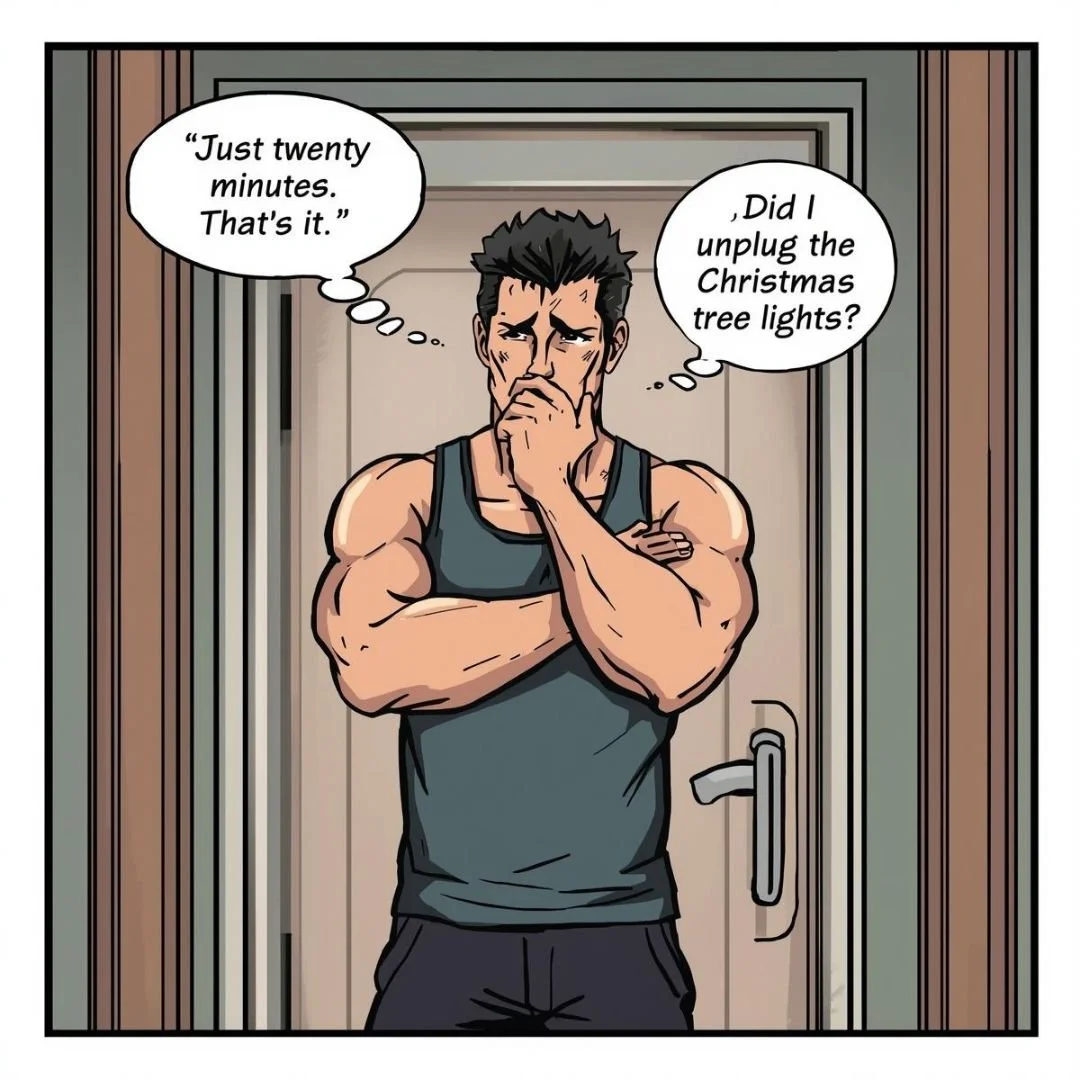
I walked into the gym with good intentions and decent posture.
Headphones charged. Water bottle full. Brain feeling… cooperative.
I stepped onto the treadmill, hit start, and told myself, “Just twenty minutes. That’s it.”
Then — like an uninvited guest with jingling keys — a thought appeared: Did I unplug the Christmas tree lights?
And just like that, my workout was no longer about movement.
It was about urgency, responsibility, and an invisible thread pulling me backward.
The Power of a Small Thought
Here’s the thing most people don’t see about ADHD:
It’s not the size of the thought that matters — it’s the weight it carries.
That Christmas tree wasn’t just a tree.
It was fire safety, family comfort, being the adult who remembers things, and not wanting to fail quietly at something no one else would notice.
So while my legs kept moving, my brain had already left the building.
Executive function doesn’t collapse dramatically — it slips out the side door.
Executive Function Isn’t Willpower
This is where ADHD gets misunderstood.
Executive function isn’t motivation or effort — it’s the brain’s ability to hold, prioritize, and sequence tasks under pressure.
According to the CDC and NIMH, ADHD affects working memory, task initiation, and emotional regulation — all things required to “just keep going.” [1] [2]
When emotional responsibility enters the picture, the system overloads.
Not because we don’t care — but because we care too much, all at once.
That treadmill didn’t lose me. The responsibility did.
Emotional Interruptions Are Real Interruptions
For people without ADHD, thoughts pass through like background noise.
For us, some thoughts hit the emergency brake.
That’s because emotional relevance hijacks attention — a process well-documented by CHADD and the Mayo Clinic. [3] [4]
Once the brain flags something as urgent, it becomes nearly impossible to return to the original task without resetting everything.
So I wasn’t being dramatic or distracted.
I was responding exactly as my brain is wired to respond.

The Moment I Felt Quietly Ashamed
Here’s the part I don’t usually say out loud.
I stepped off the treadmill early and felt that familiar sting — the one that whispers, “You couldn’t even finish this.”
No one noticed. No one judged me.
But ADHD shame doesn’t need an audience.
It lives in the gap between intention and outcome.
And it’s exhausting carrying that alone.
Why Partners Often Don’t See This
To someone watching, it looks like inconsistency.
A half-workout. A sudden change of plans. Another “almost.”
What they don’t see is the invisible labor running in parallel — the constant monitoring, remembering, preventing, managing.
Medical News Today describes this as cognitive load — and ADHD brains carry more of it, more often. [5]
So when plans dissolve, it’s rarely about laziness.
It’s about bandwidth.
What the Christmas Tree Actually Taught Me
That day didn’t teach me anything about fitness.
It taught me that ADHD isn’t loud chaos — it’s quiet rerouting.
A single thought can redirect an entire day without asking permission.
And learning to notice that without self-blame matters more than finishing the workout.
Some days, the win is awareness.
Some days, it’s grace.
A Gentle Reframe (For You or Someone You Love)

If you live with ADHD — or love someone who does — here’s the truth:
Effort doesn’t always produce visible results.
Intentions can be sincere and still collapse under invisible weight.
Support isn’t about pushing harder — it’s about understanding why the push didn’t stick.
Compassion restores momentum faster than shame ever could.
And sometimes, unplugging the tree matters more than burning calories.
Sources & Recommended Reading
Centers for Disease Control and Prevention (CDC): ADHD Overview
https://www.cdc.gov/adhdNational Institute of Mental Health (NIMH): ADHD in Adults
https://www.nimh.nih.govCHADD (Children and Adults with ADHD): Executive Function
https://chadd.orgMayo Clinic: Adult ADHD Symptoms & Causes
https://www.mayoclinic.orgMedical News Today: ADHD and Cognitive Load
https://www.medicalnewstoday.com
Tools We Quietly Rely On (Affiliate Support)
Books:
Driven to Distraction by Edward M. Hallowell, M.D.
ADHD 2.0 by Hallowell & RateyJournals & Tools:
ADHD-friendly daily planners
Guided reflection journals for emotional processing
Noise-canceling headphones for cognitive relief
One Last Question
What small thought has quietly rerouted your day — and what would change if you stopped judging yourself for it?
—
The Cynical Romantic
Where passion meets poor judgment — and occasionally, unplugged Christmas trees.
