
ADHD Relations: Building Teamwork
Understanding
Part One of Four in the series The Psychology of Love
When Life Finally Starts Making a Little Sense
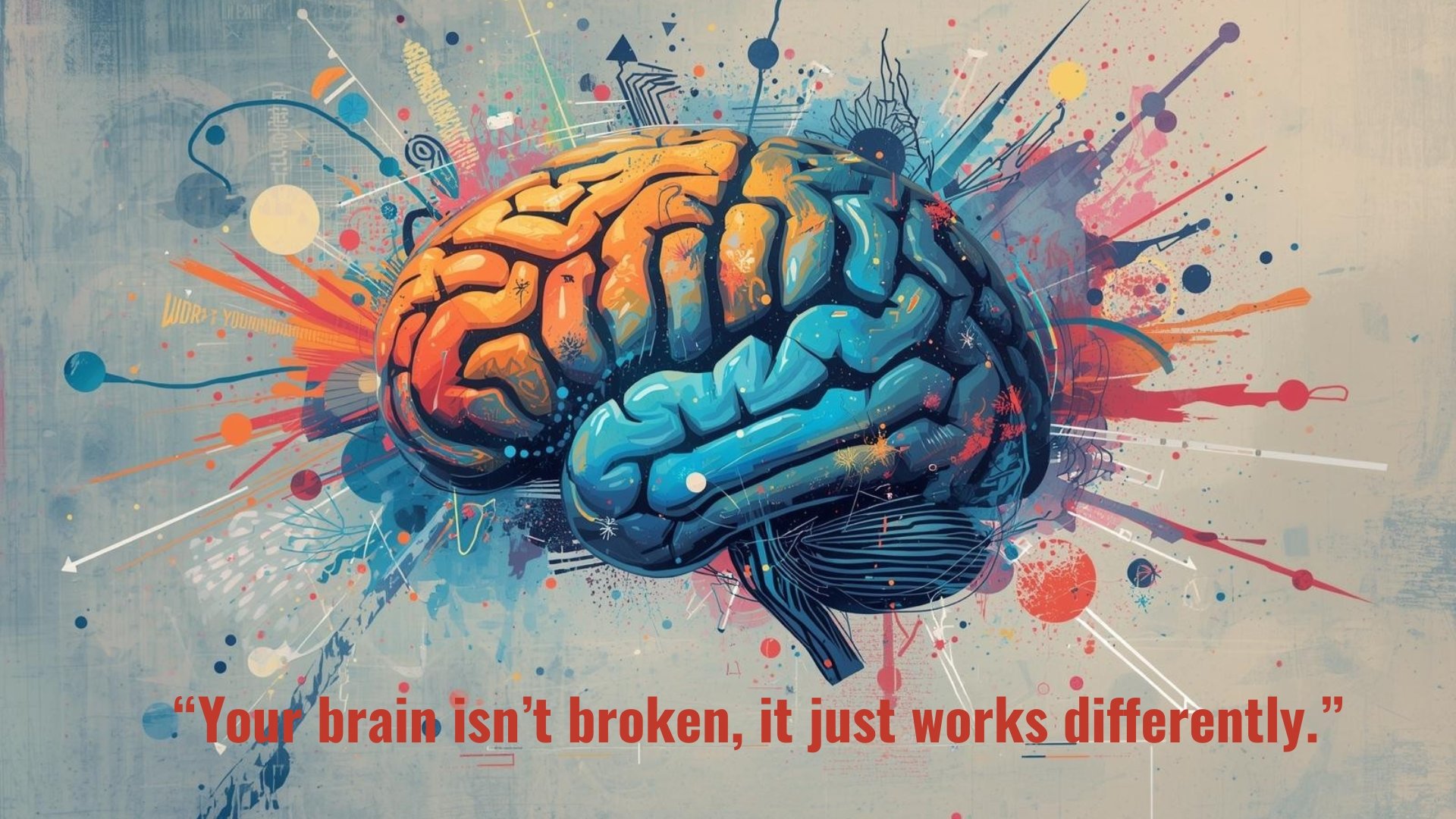
For many people, the story doesn’t begin with a diagnosis. It begins with a quiet suspicion that something about your brain works… differently.

Maybe you forget things other people remember easily.
Maybe your thoughts race ahead while conversations lag behind.
Maybe you replay the same worry in your head until it feels like your brain has accidentally hit the repeat button.
If you were diagnosed with ADHD or OCD later in life — or are beginning to suspect one of them might be part of your story — the first reaction is rarely relief.
It’s usually confusion.
Then curiosity.
Then a slow, uncomfortable realization that many of the things you once blamed on character flaws might actually have a neurological explanation.
And that moment can be both unsettling and freeing. Because when understanding arrives, shame begins to lose its grip.
ADHD: A Brain That Runs on a Different Engine
Attention Deficit Hyperactivity Disorder (ADHD) is often misunderstood as simply an inability to focus. In reality, ADHD is more accurately described as a difficulty regulating attention.
Some tasks feel almost impossible to start.
Others pull you in so deeply that hours disappear without warning. Researchers often refer to this as interest-based attention, meaning the ADHD brain focuses best when something is stimulating, novel, urgent, or emotionally engaging.
This is why someone with ADHD may struggle to start paying bills but can spend three hours researching the history of medieval swords without noticing the passage of time.
The brain isn’t lazy. It’s wired differently.
According to the Centers for Disease Control and Prevention (CDC), ADHD affects millions of adults in the United States, though many were never diagnosed in childhood.
For decades, the condition was misunderstood as a childhood behavior issue rather than a lifelong neurological difference.
Today we know better.
ADHD involves differences in brain regions responsible for executive function — the mental skills that help us plan, organize, regulate emotions, and manage time.
And when those systems run a little differently, everyday life can sometimes feel like trying to operate a complicated machine without the instruction manual.
OCD: When the Brain Won’t Let a Thought Go
Obsessive Compulsive Disorder (OCD) is another condition that suffers from widespread misunderstanding. Many people think OCD simply means liking things clean or organized. In reality, OCD is far more complex and often far more distressing.
OCD involves two primary components:
Obsessions — intrusive thoughts, images, or fears that repeatedly enter the mind.
Compulsions — behaviors or mental rituals performed to reduce the anxiety those thoughts create.
These compulsions can take many forms:
• Rechecking locks or appliances
• Excessive cleaning
• Repeating phrases or mental counting
• Seeking constant reassurance
• Avoiding situations that trigger anxiety
But the key thing to understand is this:
People with OCD usually know their fears are irrational.
That doesn’t make the anxiety disappear.
It simply means the brain keeps ringing an alarm bell that logic alone cannot silence.
The National Institute of Mental Health (NIMH) describes OCD as a disorder involving disruptions in brain circuits related to fear and decision-making. These circuits become stuck in a loop, causing the mind to revisit the same thoughts again and again.
It’s not about perfectionism.
It’s about a brain trying desperately to find certainty in a world that refuses to provide it.
When ADHD and OCD Share the Same Mind
Here’s where things get particularly interesting — and often confusing.
ADHD and OCD can sometimes exist in the same person. At first glance, this sounds contradictory.
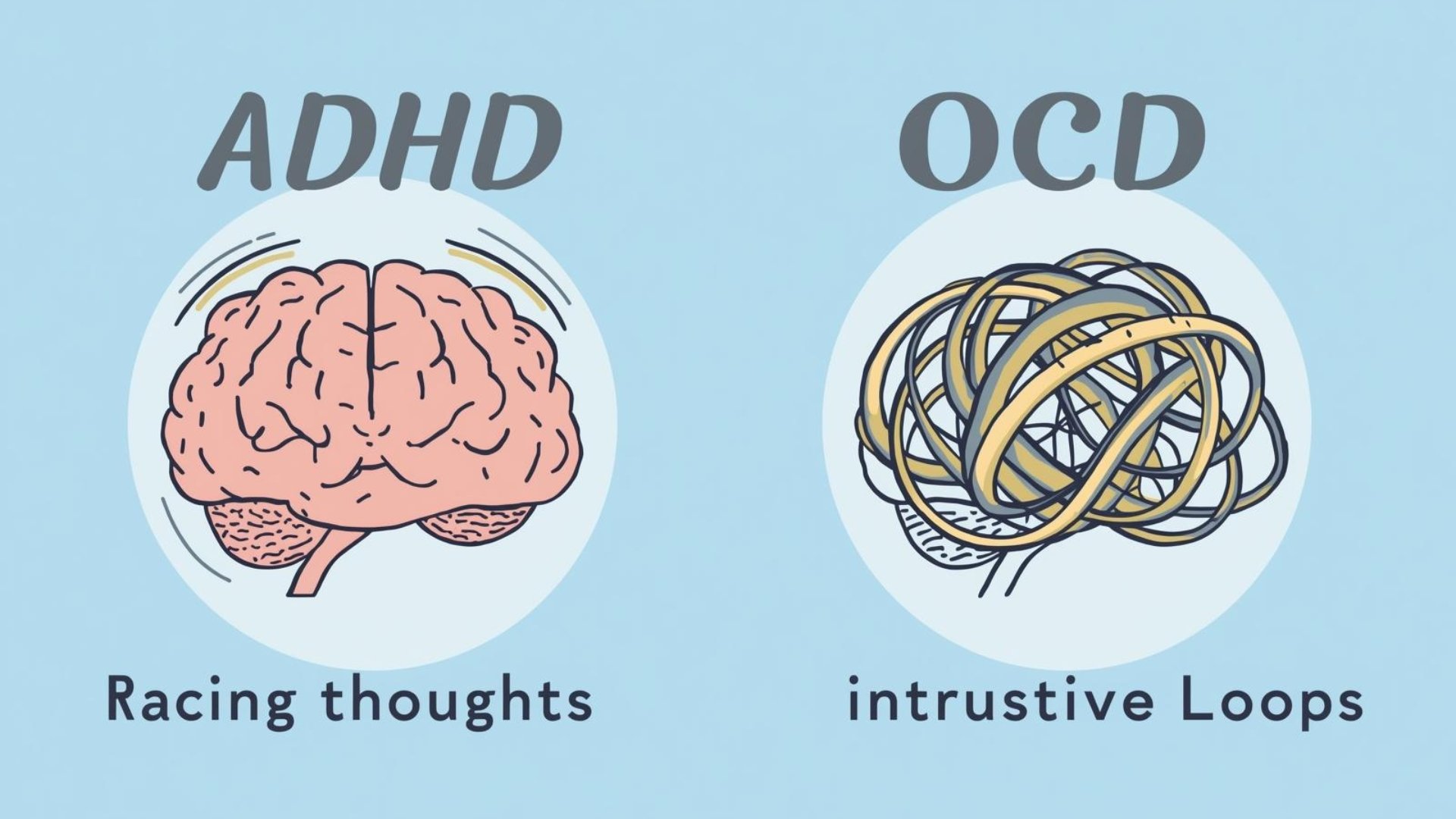
ADHD is associated with impulsivity and scattered thinking.
OCD is associated with repetitive thoughts and rigid patterns.
But the human brain is not always neat and tidy. Someone with both conditions may experience:
• Racing thoughts and obsessive worries
• Impulsivity and overthinking
• Disorganization and moments of intense control
It can feel like having two different internal forces pulling in opposite directions. One part of the brain wants to jump forward. Another part wants to double-check everything before moving. And when those two systems collide, life can feel both exhausting and confusing.
Understanding this overlap is important because treatment strategies often need to address both attention regulation and anxiety management.
The good news is that research and clinical understanding have improved dramatically in the past two decades. And many people who once felt lost inside their own minds now have tools that help them navigate it.
The Late Diagnosis Reality
For many adults, diagnosis arrives decades after the symptoms first appeared.
Maybe childhood teachers described you as “bright but distracted.”
Maybe family members called you “too sensitive” or “a worrier.”
Over time, those labels can quietly shape how a person sees themselves.
Lazy.
Disorganized.
Overdramatic.
Difficult.
When a diagnosis finally arrives — sometimes in a therapist’s office, sometimes after a late-night internet search — it can feel like someone finally handed you a map to a place you’ve been wandering through your entire life.
That moment can be emotional. Some people feel relief. Others feel anger that no one recognized the signs earlier.
And many feel a strange mix of both. But understanding doesn’t change the past. It changes what comes next.
A Quiet Moment of Recognition
If you’re reading this and pieces of it feel familiar, take a moment.

You’re not alone.
Millions of adults are discovering later in life that the challenges they struggled with for years were never about intelligence, effort, or willpower. They were about how their brain processes attention, anxiety, and uncertainty. That realization doesn’t magically solve everything.
But it does open the door to something incredibly powerful.
Self-understanding.
And once that door opens, the next step becomes possible. Learning how to explain your brain — to yourself and to others.
That’s where we’re headed next.
A Question To Sit With
When you look back at your life so far…
What is one moment that makes more sense now than it did at the time?
Part 3 — Communication
How to explain ADHD/OCD to partners, friends, and coworkers without sounding like you’re making excuses.
Sources & Recommended Reading
Centers for Disease Control and Prevention (CDC)
Adult ADHD overview
https://www.cdc.gov/adhd
National Institute of Mental Health (NIMH)
Obsessive Compulsive Disorder
https://www.nimh.nih.gov/health/topics/obsessive-compulsive-disorder-ocd
CHADD (Children and Adults with ADHD)
Evidence-based ADHD resources
https://chadd.org
Mayo Clinic
ADHD symptoms and causes
https://www.mayoclinic.org/diseases-conditions/adhd
Medical News Today
Understanding ADHD and OCD overlap
https://www.medicalnewstoday.com
Tools & Books That Help (Affiliate Recommendations)
Some readers like having deeper resources as they begin understanding their brains. These are widely respected and reader-friendly.
Driven to Distraction — Edward Hallowell, M.D.
A classic book that helped many adults recognize ADHD patterns.
The OCD Workbook — Bruce Hyman & Cherry Pedrick
A practical, step-by-step guide used by therapists and patients alike.
Atomic Habits — James Clear
Not an ADHD book specifically, but incredibly helpful for building systems when motivation fluctuates.
(Some links on this page may be affiliate links. If you choose to purchase through them, it helps support the site at no additional cost to you.)
